Alex Ketchum and Monica Storss have been named Women@MIT fellows for 2026. The fellowship invites scholars, activists, artists, musicians, writers, and others to showcase the Women@MIT collections in informative and engaging ways. Ketchum and Storss will engage in archival research to create projects that contribute to greater understanding of the history of women at MIT and in the history of STEM, using the rich materials in the Department of Distinctive Collections.
“This year’s Women@MIT fellows not only shed light on the role of MIT women in shaping emerging technologies, their projects combine the physical and the digital to create dynamic and engaging experiences with our archival collections,” says Emilie Songolo, head of Distinctive Collections at MIT Libraries.
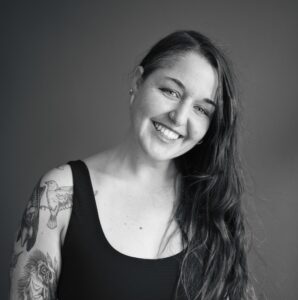 Alex Ketchum, PhD
Ketchum (she/her) is an Associate Professor at McGill University’s Institute for Gender, Sexuality, and Feminist Studies and the Director of the Just Feminist Tech and Scholarship Lab. Her work integrates queer and feminist, labor, tech, and food history. She is an elected member of the Royal Society of Canada: College of New Scholars and the author of several books including Engage in Public Scholarship!: A Guidebook on Feminist and Accessible Communication (2022), Ingredients for Revolution: A History of American Feminist Restaurants, Cafes, and Coffeehouses (2022), How to Organize Inclusive Events and Conferences (2026), and the forthcoming Digital Queers, and High Tech Gays: A History of LGBTQ+ Cyber Activism (2027). She is also co-editor of the anthology Queers at the Table: An Illustrated Guide to Queer Food with Recipes (2025).
Ketchum’s project “MIT’s Lesbian, Bisexual and Queer Women and the Creation of Digital Infrastructure for the LGBTQ+ Internet” focuses on the role of MIT’s lesbian, bisexual, and queer women students, faculty, and alumnae in shaping a queerer Internet, from ARPANET to Planet Out and LAMBDAZONE, and the role MIT played in supporting the early internet. The research will lead to the production of an online exhibit with a complimentary physical and digital zine
 Monica Storss
Storss (she/her) is a poet, theorist, and researcher working across extended reality, augmented reality, artificial intelligence, and experimental publishing. Her creative and scholarly projects examine emerging technologies as sites of poetic practice, critical inquiry, and cultural transformation. She is the creator of The Augmented Reality Poetry Machine, which debuted at MIT’s Hacking Arts conference in 2019 and was sent to Earth’s moon in 2021, and The Oracles, an AI language model trained on her own writing corpus and published in 2024. Her professional background spans digital transformation, organizational learning, and emerging technology strategy across industry, higher education, nonprofits, and start-ups, with experience at HP, Intel, Xerox, and MIT. Storss was editor of The Greenbelt Review and, in 2025, edited one of the first collections of XR creative writing for a special issue of Re:mediate. She is a reviewer for ACM’s Creativity and Cognition and a guest editor at Digital Humanities Now. Her research appears in Routledge, Springer Nature, and other outlets. She is Scholar-in-Residence at Northeastern University’s Digital Integration Teaching Initiative and a PhD student in Interdisciplinary Design and Media at Northeastern.
Storss’s project “Women’s Work: Making the Mediums” recovers, celebrates, and re-presents the experimental media practices of women at MIT in the pre-Y2K era – before the interface became ubiquitous, before digital culture settled into its current forms, women at MIT were part of the emergence of new media: building early video systems, building books without pages, composing for synthesizers and tape, and designing interactive environments without a vocabulary for what they were designing. Her final project will be a physical zine with an augmented reality layer that will construct a portrait of women whose creative and technical contributions shaped emergent media forms.
The Women@MIT archival initiative seeks to add the records of women faculty, staff, students, and alumnae to the historic record by collecting, preserving, and sharing their life and work with MIT and global audiences. These efforts are made possible thanks to the generous support of Barbara Ostrom ‘78 and Shirley Sontheimer with the hope that this project will encourage more women and underrepresented people to become engaged in science, technology, and engineering. Extending from this initiative, Distinctive Collections also is committed to acquiring, preserving, and making accessible the papers of gender non-binary and non-conforming individuals at MIT to help share their stories and contributions. Collections, events, fellowships, and exhibits held by the Women@MIT initiative are open to all regardless of background or identity.