“When you lose a language, a large part of the culture goes, too, because much of that culture is encoded in the language.” -Kenneth Hale
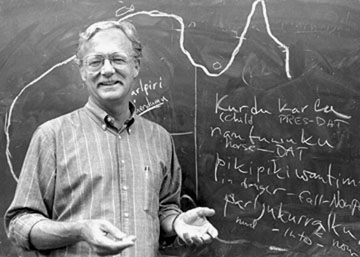
Kenneth Hale, MIT Spectrum, 1989. Photo J.D. Sloan.
A renowned linguist and activist for endangered languages, Kenneth L. Hale (1934-2001) was professor of linguistics at MIT, where he taught for three decades. MIT Libraries’ Distinctive Collections is home to Hale’s papers, which he and his wife, Sara (Sally) Hale, donated in several installments in the late 1990s and early 2000s. Among them are recordings and field notes from the 1950s to the 1970s of more than 80 distinct languages and dialects from around the world, predominantly Indigenous languages.
In 2024, the MIT Libraries’ Distinctive Collections received a Recordings at Risk grant from the Council on Library and Information Resources (CLIR) for a project to digitize these recordings. Led by Libraries staff members Rachel Van Unen, Ece Turnator, Amanda Hawk, and Jenn Morris, the project was recently completed and resulted in nearly 600 hours of digital content, as well as nearly 4,000 images documenting the tape cases.
Hale’s tapes appear to be mostly field recordings, language lessons, and other documentation of the endangered languages that he studied, often recorded on his research trips. The majority of the languages originate from the present-day southwest region of the United States, Mexico, and Australia. These recordings are invaluable for the communities now doing language restoration work and for future linguistic research. In the case of some languages with very few fluent speakers left, Hale’s recordings are some of the last linguistic resources remaining.
For the project team, ensuring the long-term preservation of the recordings was just one aspect of their goal – a thoughtful process for evaluating the recordings’ content and determining corresponding access and use policies would be just as crucial. “We wanted to approach working with an Indigenous language collection with the appropriate level of expertise and an ethic of care,” says Hawk.
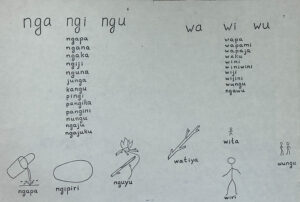
Pages 6 and 7 of “A Warlpiri Syllabary” by Ken Hale, 1974, Kenneth L. Hale Papers, MC-0523, Box 99. Department of Distinctive Collections, MIT Libraries, Cambridge, Massachusetts.
To that end, the Libraries assembled an advisory group of Indigenous language speakers, professors of linguistics, special collections professionals, and language technology experts. The group provided feedback on policies and terminology as well as assistance with contacting native speakers. The project team continues to reach out to the different language communities represented in the recordings in order to establish a shared understanding with those communities about how the tapes should be preserved and described, whether the original media should be returned, rights to the content, and who should have access.
“From the beginning, our goal with this project has been to partner with language communities in the long-term stewardship of the recordings,” says Van Unen. “Our work with the Indigenous groups represented in the collection will be ongoing to ensure we are providing broad access to the recordings while respecting culturally sensitive content and the evolving needs of the creator communities.”
By the Numbers:
The Kenneth Hale Language Recordings
- 333 open reels
- 365 audio cassettes
- 4 VHS tapes
- 590 hours of content digitized
![[ OPEN HOUSE ] Howe, Manning & Almy: Boston’s First All-Woman Firm and the Changing Face of Architecture](https://libraries.mit.edu/app/uploads/sites/4/2026/09/HMA-exhibit_web-scaled_323x111_acf_cropped.jpeg)