The fifth annual MIT Prize for Open Data, which included a $2,500 cash prize, was recently awarded to eight individual and group research projects. Presented jointly by the School of Science and the MIT Libraries, the prize highlights the value of open data — research data that is openly accessible and reusable — at the Institute.
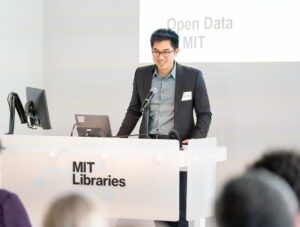
Shiwei Mitchell-Wang. Photo by Bryce Vickmark.
The prize winners and 10 honorable mention recipients were honored at the Open Data @ MIT event held Oct. 20 at Hayden Library. The event featured remarks by Shiwei Mitchell-Wang PhD ‘26, who, together with Teddy Warner, spearheaded the MIT’s Graduate Student Council’s Resolution on Scientific Publishing and MIT Libraries. The resolution, which urges concrete actions such as signing MIT’s opt-in open access license and reevaluating mentorship in graduate education, is part of a history of MIT graduate students’ advocacy, said Mitchell-Wang. “Graduate students have long been advocates and practitioners of open data and open science,” he said. “We come to MIT to be better scientists and to push the boundaries of human knowledge.”
In her remarks, Chris Bourg, vice provost and Barbara K. Ostrom (1978) Director of the Libraries, noted the evolution of the MIT Prize for Open Data, which marked its fifth and final year in 2026: ”Over the life of the prize, we have moved from recognizing open data as something researchers share at the end of a project to recognizing it as core infrastructure for discovery, public problem-solving, and increasingly for trustworthy AI.”
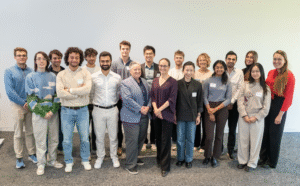
2026 MIT Prize for Open Data honorees. Photo by Bryce Vickmark.
Bourg also reflected on the impact the prize has had over the past five years. Previous recipients have reported how the prize supported publication of their research and continued open sharing of their data, while others shared that it gave their research credibility and visibility. “This prize has not only celebrated but generated collaboration, transparency, and real-world impact,” said Bourg.
Initiated by Bourg and Rebecca Saxe, associate dean of the School of Science and the John W. Jarve (1978) Professor of Brain and Cognitive Science, the MIT Prize for Open Data recognizes early-career MIT-affiliated researchers who use or share open data, create infrastructure for open data sharing, or theorize about open data. More than 60 nominations were submitted from across the Institute, and a committee composed of faculty, staff, and graduate students made the selections.
2026 Winners
- Differentially Private Synthetic Data Generation is a groundbreaking method that addresses a fundamental barrier to open science: sharing the scientific value of sensitive, interconnected data while rigorously protecting individual privacy. The team includes Kaveh Alim, Hao Wang, Ojas Gulati, Akash Srivastava, and Navid Azizan.
- Matteo Di Bernardo and Roshan Kern won for Brieflow, an open-source pipeline that turns raw images from large-scale CRISPR screens into standardized per-cell data and browsable maps of gene function, built from modular components that any lab can adapt to its own microscopes and assays.
- Kexin Dong, Samuel I. Gould, and Francisco J. Sánchez Rivera were recognized for “Computational prediction of human genetic variants in the mouse genome.” H2M (human-to-mouse) is an open-source computational pipeline that automates the prediction of human variants in the mouse genome and generated a first-of-this-kind open dataset of a dictionary of 3,171,709 cross-species variant mappings.
- The Sensing Garden team from the MIT Senseable City Lab – Åse Håtveit, Orlando Closs, and Titus Venverloo – won for Flik, an open-source, low-cost monitoring system that addresses critical baseline data scarcity in global insect ecology. By combining real-time edge computer vision with synchronous microclimate and air quality sensing, Flik delivers biological and abiotic datasets required to untangle the drivers of urban insect decline.
- Lennart Justen accepted on behalf of the CASPER consortium for “Deep untargeted wastewater metagenomic sequencing from sewersheds across the United States.” The project publishes data from an active U.S. network using deep, untargeted wastewater metagenomic sequencing to bolster national and global pandemic early warning capabilities while opening a broad new window into the microbial ecology of our cities.
- Eric Anton Moreno, Nicole Hartman, and Philip Harris were recognized for “COLLIDE-2V: an open, dual-view dataset of one billion simulated LHC collisions for machine learning.” This 50TB public dataset gives collider physics its first shared, general-purpose training corpus for machine learning.
- Ghadi Nehme, Brandon Man, Md Ferdous Alam, and Faez Ahmed won for “VideoCAD: A Dataset and Model for Learning Long-Horizon 3D CAD UI Interactions from Video.” This open dataset of more than 41,000 annotated CAD interaction videos enables AI systems to learn how to operate professional design software and reason about 3D geometry.
- Ben Workman was recognized for “Inside the Black Box: Using Machine Learning to Predict and Understand Effective Teaching.” This project reanalyzes an existing dataset of elementary school math lessons, linked to information about student achievement, to predict and better understand teachers’ effects on student learning.
A complete list of winning projects and honorable mentions, including links to the research data, is available on the MIT Libraries’ Open Data website.