In 2016, MIT Libraries’ Distinctive Collections launched a new effort aimed at acquiring, preserving, and making accessible the personal archives of women at MIT, generously supported by Barbara Ostrom ’78 and Shirley Sontheimer. As the initiative approaches its 10th anniversary, Bibliotech takes a look back at efforts to grow and invite active engagement with the collections.
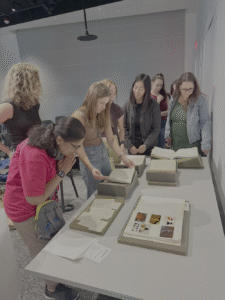
“Dive Into the Archives” event with MIT Graduate Womxn in Biology. Photo: Julia Van Goor
Filling the Gaps
The Libraries launched the initiative to address the absence of MIT women from the historical record. The impact of these omissions is twofold: “These gaps not only limit our understanding of past scientific achievements but also impact the visibility of women scientists who could serve as role models to inspire future generations of women in STEM,” says Women@MIT Archivist Thera Webb.
The first phase of the Women@MIT initiative was focused on building the collections and forging relationships with faculty ending the active phase of their careers. Faculty members who added their personal collections in the first year include Nancy Hopkins, Amgen Inc. Professor of Biology Emerita, known for bringing about an investigation that resulted in the landmark 1999 report on the status of women at MIT; Mary Rowe, adjunct professor at MIT Sloan, special assistant to the president, and ombudsperson whose work contributed to MIT having one of the world’s first anti-harassment policies; and Sheila Widnall ’60, SM ’61, ScD ’64, Institute Professor and professor of aeronautics and astronautics, the first woman to serve as secretary of the Air Force, and the first woman to lead a branch of the U.S. military.
Since 2016, there have been more than 100 accessions of new material into the collections, comprising more than one million pages and more than one terabyte of born-digital material. They include the papers of the first Asian woman to receive tenure at MIT, ChoKyun Rha, a professor of biomaterials science and engineering who helped found biotechnology firm Genzyme, and economist Phyllis Wallace, the first tenured Black woman at MIT and the first tenured woman at MIT Sloan. The scope of the initiative has also widened to include staff, students, and alumnae. Distinctive Collections houses the physical and digital archives of the Margaret MacVicar Memorial AMITA Oral History Project, which chronicles the lives of MIT alumnae through interviews conducted by undergraduates.
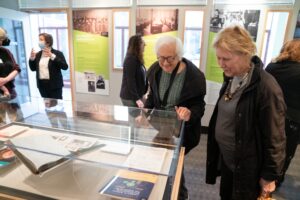
“Under the Lens: Women Biologists and Chemists at MIT 1865-2024.” Photo by Bryce Vickmark
Engaging with History
As the collections have grown, so too have the Libraries’ efforts to make women’s collections accessible to more people and to create opportunities to engage with them. In addition to digitizing materials – 17 collections have been made available on MIT Digital Collections – Distinctive Collections staff have expanded their outreach with MIT classes, student groups, and alumnae, as well as broader audiences. The Women@MIT Fellowship, launched in 2021, provides funding for artists, writers, filmmakers, historians, and others to create projects that invite the community to engage with different aspects of the collections.
“Now that MIT’s Distinctive Collections is more established as a hub for preserving the contributions of MIT women, we can expand our focus to increasing the collection’s use,” says Webb.
In the last five years:
- 32 MIT classes, representing 11 different departments and programs, have used Women@MIT materials in class visits;
- 6 exhibits, both physical and digital, have showcased the collections;
- 13 MIT community and public events have given audiences insights into and hands-on experiences with the collections;
- 3 podcasts have featured Women@MIT archivists discussing the work of preserving the history of women in science;
- 7 Women@MIT Fellows have created projects that increase engagement with the collections, including a video game, a hypertext novel, and a short documentary;
- 399 requests for Women@MIT materials have been made by Distinctive Collections Reading Room researchers.
It’s opportunities like these where audiences – from the MIT Graduate Womxn in Biology group to kids at the Cambridge Science Carnival – can be inspired by these pioneering women. That’s part of the mission, according to Distinctive Collections Head Emilie Songolo: “Archives have the potential to bring together communities. Seeing oneself represented creates a powerful sense of belonging,” she says. “Preserving and making accessible the contributions that MIT women have made to science tell a deeper and more accurate story of the Institute. If these contributions are recognized and taken forward, we all benefit.”